Building community is a key part of successful relationships and developing society. This past week I have been participating in the new teachers academy for Cobb, and during the first orientation session they told us that in 5 years about 35-40% of us will leave the teaching profession. That’s a terrifyingly high number, and to be honest I would rather not have the knowledge rattling around in my brain. So how do I make sure (at least to the best of my ability) that I don’t fall into that statistic? Well, I can’t make sure of it. There are no guaranties in life. But I’m not going to let my enthusiasm for teaching be dulled by a number.
I don’t have an answer as to why so many teachers choose to leave the profession. Maybe it’s because of the salary. Maybe it’s because of the student to teacher ratio. Maybe it’s because of the number of hours that are required outside of school. Or maybe it’s because there was a lack of support.
I have heard of people who have chosen to stay at jobs that they weren’t passionate about or that were incredibly stressful because they had a great support team among their co-workers. I understand the important of building a PLN and utilizing their resources. PLN’s provide a chance for people to share ideas, tools, advise, and even provide an ear when you just need to vent about something that is frustrating you.
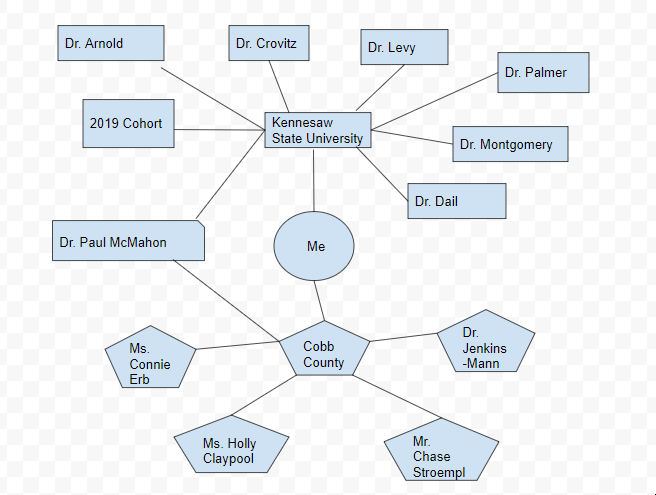
Posted above is a diagram of my current PLN. I created this diagram through Google drive under “Google Drawings,” from there I inserted shapes and lines. It was an incredibly easy process, and once I was done with my diagram I took a screenshot of it and uploaded it as an image to this post. Some of the other websites that I looked up to make this diagram required that I sign up or create an account. Since I already have an account on Google Drive I decided to skip the “sign up” step.
My current PLN has two sections, although there are some instances in which they overlap. The first section is the network I’ve built from Kennesaw State University. This section consists of professors, classmates, and field supervisors. My classmates have provided me with valuable information about classroom management and how to handle certain situations. My professors have provided me with a foundation of what to expect from both the administration and the state in regards to meeting standards and creating lesson plans. My field supervisor, Dr. McMahon, is linked to both sections. He was my supervisor through KSU, but he also was a principal and assistant principal for many years in Cobb. Dr. McMahon was an fantastic resource to have for learning about what to expect from Cobb and he also was kind enough to offer me a letter of recommendation. The second section is focused on my network that I have developed from Cobb. I am certain that as I continue to build relationships that this section with increase in size. But, so far, it included the principal and assistant principals at my new school and my CT from student teaching.
I am so incredibly grateful for my experience in this program. Although my time in this program has been unconventional, I feel like I have made strong connections with my cohorts. I plan to keep in contact with them through Facebook and Google Drive, it will be nice to have people to talk to who are also going through the stress of their first year of teaching. I am also grateful to the professors in this program who have been nothing but supportive and understanding about the ups and downs we have gone through.
Advise for new teachers:
-Seek out people in your field to help build your network
-Make strong connections to your coworkers, you never know when you will need their help
-Don’t be afraid to ask questions
-Remember that this can be a scary process and always be ready and willing to help other
“newbies.”
 Notorious Bookworm